Radon Testing Longmont, Boulder, Loveland & the Surrounding Area

Radon Danger

Total Home Inspection Services LLC provides radon testing as an add-on to a home inspection or as a stand-alone service in Loveland & Longmont, CO. I use modern continuous digital radon monitors that are calibrated annually and provide results immediately upon completion of the testing period (48 hours minimum). The results include not only the average exposure over the testing period but also hourly radon levels within the home. This additional information is extremely useful — I have tested several homes where the average radon exposure is below the EPA threshold, but there are drastic spikes in levels in the middle of the night, when it is likely the home is occupied.

Radon levels within a home can vary with the season, barometric pressure, and the weather. The EPA recommends testing for radon within the home every two years- to determine if you need a mitigation system, or to confirm the efficacy of an installed system.

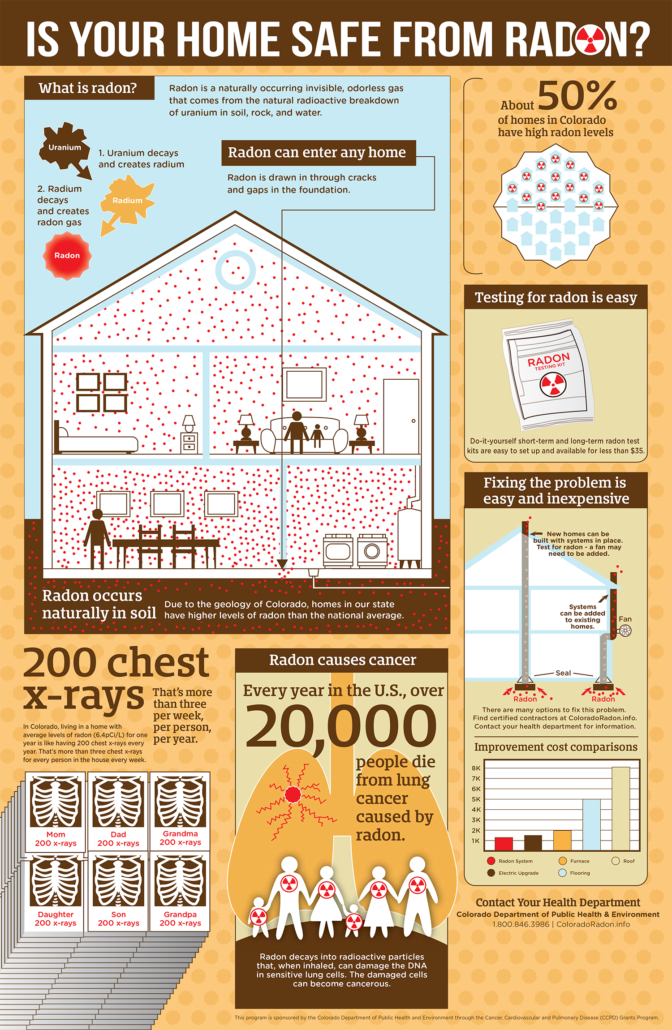
What is Radon, and Why Should I Test For It?

  • Radon has no color, odor, or taste and doesn’t cause short-term symptoms of illness.
  • Radon causes cancer.
    • It’s estimated to cause about 21,000 lung cancer deaths per year in the United States.
    • It’s the second leading cause of lung cancer in the United States, according to the Surgeon General.
    • Only smoking causes more lung cancer deaths.
  • Radon is a naturally occurring radioactive gas that comes from the breakdown of uranium in the soil.
    • It’s a gas that rises through the soil into the atmosphere.
  • ​High radon levels have been found in all 50 states and throughout Colorado.
  • In Colorado, about half the homes have radon levels higher than the U.S. Environmental Protection Agency recommended action level of 4 picocuries per liter (pCi/L)
  • The most effective solution is usually a sub-slab (or, if you have a crawl space, sub-membrane) depressurization system.
  • A mitigation system in Colorado usually costs about $800-$1,200 unless difficult design problems are encountered.

Radon FAQs

Clear, expert answers to the questions Colorado homeowners ask most about radon testing, interpreting results, and protecting their households.

Radon is a naturally occurring radioactive gas — invisible, odorless, and tasteless — produced by the radioactive decay of uranium present in soil, rock, and groundwater. Because it cannot be detected by human senses, professional testing is the only reliable way to know whether elevated radon levels exist in your home.

According to the EPA’s most recent risk assessment, indoor radon is responsible for approximately 21,000 lung cancer deaths in the United States each year — making it the leading cause of lung cancer among non-smokers. Colorado is among the top ten highest-radon states in the country, a direct result of its uranium-rich granite geology. Roughly 50% of tested Colorado homes exceed the EPA’s action level of 4.0 picocuries per liter (pCi/L), making professional radon testing an essential step for any Colorado homeowner.

Radon migrates upward through the soil and enters homes through foundation cracks, construction joints, gaps around service pipes, and other openings in the building envelope. Once inside, it accumulates — particularly in lower levels — often reaching dangerous concentrations. No home is immune. New construction and older homes, tightly sealed and drafty structures, and properties with or without basements are all susceptible.

Testing with Total Home Inspection Services is simple and non-disruptive. Once your appointment is scheduled, a Colorado-licensed Radon Measurement Professional will deploy a commercial-grade continuous radon monitor in the appropriate area of your home. After a 48-hour measurement period — the standard required for a valid short-term test — the device is retrieved and the data is analyzed. You will receive your complete results that same evening, including both the 48-hour average and a graph of hourly readings throughout the test period.

The EPA recommends installing a radon mitigation system when indoor levels exceed 4 pCi/L, and strongly encourages considering mitigation for levels between 2 and 4 pCi/L. The World Health Organization (WHO) sets its recommended action threshold at 2.7 pCi/L. To put elevated levels in perspective: living in a home with a radon concentration of 6.4 pCi/L is roughly equivalent to the radiation exposure from 200 chest X-rays per year. Even levels in the 2–4 pCi/L range carry measurable long-term risk.

Elevated radon levels are a serious but entirely solvable problem. I will connect you with a vetted, reputable radon mitigation contractor who will assess your property and design an appropriate system. The most common approach — sub-slab depressurization — involves drilling a small hole in the basement floor, inserting a pipe beneath the slab, routing it through an exterior wall, attaching a continuously operating fan, and extending the pipe above the roofline. In crawlspace applications, a perforated pipe runs the perimeter beneath sealed plastic sheeting, connected to the same exterior pipe and fan system. Mitigation is straightforward, minimally invasive, and highly effective. A follow-up radon test after installation confirms the system is performing as intended.

Yes — and it is strongly recommended. The EPA advises retesting every two years regardless of whether a mitigation system is in place. For homes without a system, periodic retesting ensures that radon levels have not increased over time due to changes in the soil or building envelope. For homes with an existing mitigation system, retesting confirms the system is operating effectively and that radon levels remain safely below action thresholds.

Not necessarily. Radon levels can vary significantly between adjacent properties — sometimes dramatically so. Radon travels through the soil along the path of least resistance, which is highly dependent on soil composition, subsurface structure, and local geological conditions. Those pathways shift with changes in barometric pressure, precipitation, and ground disturbances such as nearby construction. The only way to know your home’s radon concentration is to test it directly.